




Grade 4
Students in Grade 4 use their understanding of the Base-10 number system to make connections between common models, benchmark values (friendly numbers), and the 4 basic operations. As such, the emphasis is on developing estimation strategies, including rounding, and using various models to organize and communicate multi-step problem solving involving addition, subtraction, multiplication, and division. Particular attention is paid to understanding number facts as groups of related values (number families), similar to the "Friends of 10" concept in primary grades. 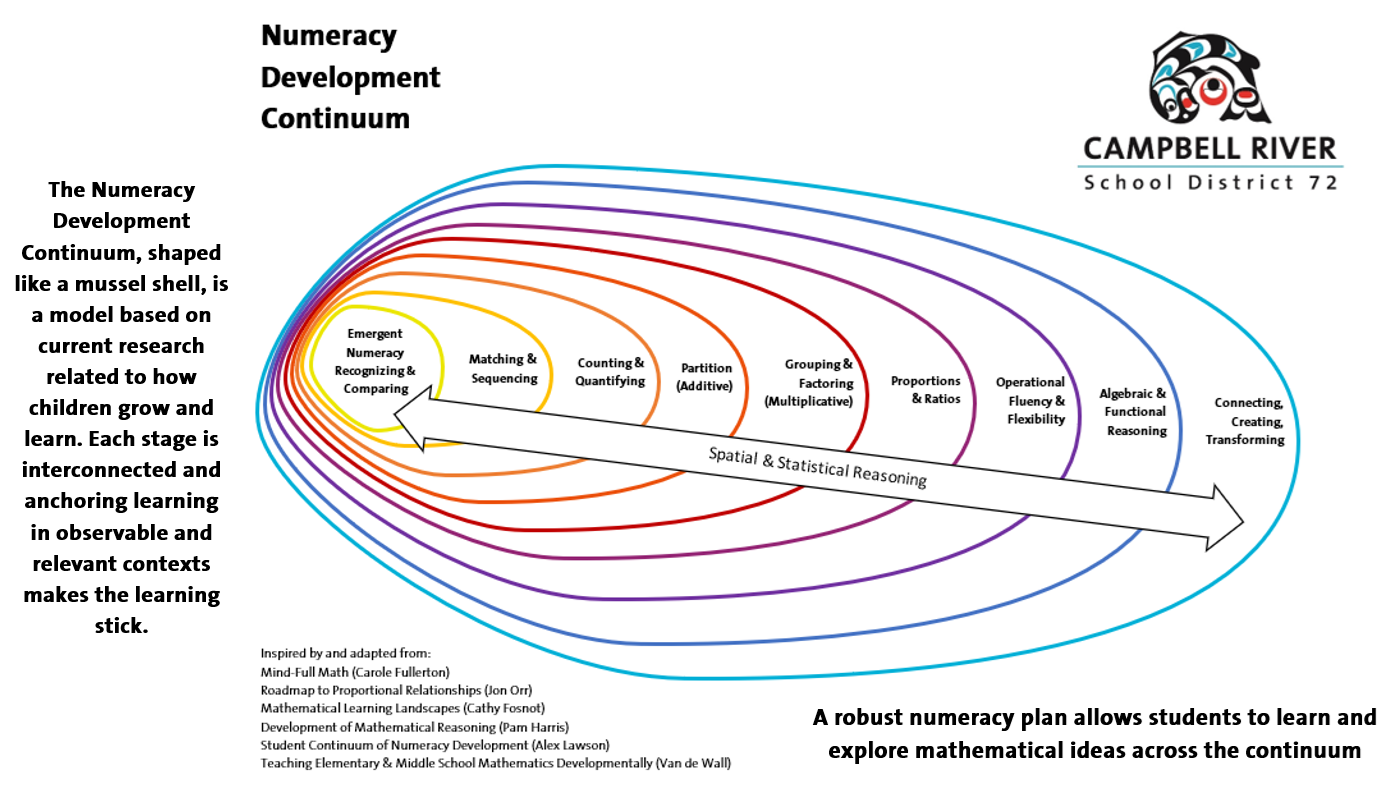
In the table below, you will find instructional resources organized by theme as well as according to discrete skills for Grade 4 Math (ie. Understanding Place Value, Addition/Subtraction, Multiplication/Division, etc.)
Note:
Operational Fluency refers to ease of recognition of which operation is required for a given problem and Computational Fluency (the proficient use of various models and strategies to perform the desired operation)
Brochure which summarizes the strategies & models seen in this grade
| Numeracy 4 Year Plan.pdf | Curricular Competencies | |||
| Planning for Proficiency BIG IDEAS K-9 | Understanding & Solving (activate curiosity, play, practice, recall) | Communicating & Representing (use vocabulary, notation & draw visualizations) Modelling in Math K-12 Trajectory | Reasoning & Analyzing (Use logic, infer missing information, use & interpret patterns, compare, equate) Measurement in Math Trajectory | Connecting & Reflecting (Consolidate understanding, think creatively, connect ideas, seek challenges) Self-Assessment Math 4&5 |
| Common Models for Gr.4 |
|
|
| Literacy Connections Digital Literacy Connections |
| Benchmark Values (Base-Ten) |
|
|
| Financial Literacy Connection
|
| Benchmark Values (Fractions) | Understand benchmark fractions
| Name and Represent Fractions | Financial Literacy Connection
| |
| Addition/Subtraction Pythagorean Tables (Addition/Subtraction, English) Pythagorean Tables (Addition/Subtraction, French) |
|
|
| Art Connection |
| Multiplication/Division Multiplication Math Pack |
|
| Proportional Reasoning
| Financial Literacy Connection
|
| Culturally Sustaining Pedagogy | Connecting to Place Exploring West Coast Ecosystems Life cycles of local plant and animal species
| Connecting to Language
| Connecting to Culture and Community
| Science & Social Studies Connections
|
Instructional and Assessment Routines
| Common Formative Numeracy Assessment (CFNA) Section 8 of the District Numeracy Framework SNAP Number Sense Instructional Routine SNAP Grades 2-9 Recommended Resource: Number Sense Booklets from "Penny Drop Teaching" | |
| Games for Fluency Building in Math BEAM Math Games for Grades 3-5 | High-Yield Routines for Elementary Curated list with links to recommended resources |

 Google Translate