




Grade 7
Students in Grade 7 expand their computational fluency and proportional reasoning using rational numbers (including fractions, decimals, percentages, and negative values). As such, the emphasis is ratios & proportions, use of common geometric formulas and solving equations with whole number solutions. Student begin using symbolic logic (algebra) to communicate multi-step problem solving. Visual models include graphing on a number line and a cartesian plane, array/area models of multiplication/factors and visual patterns with input/output tables.
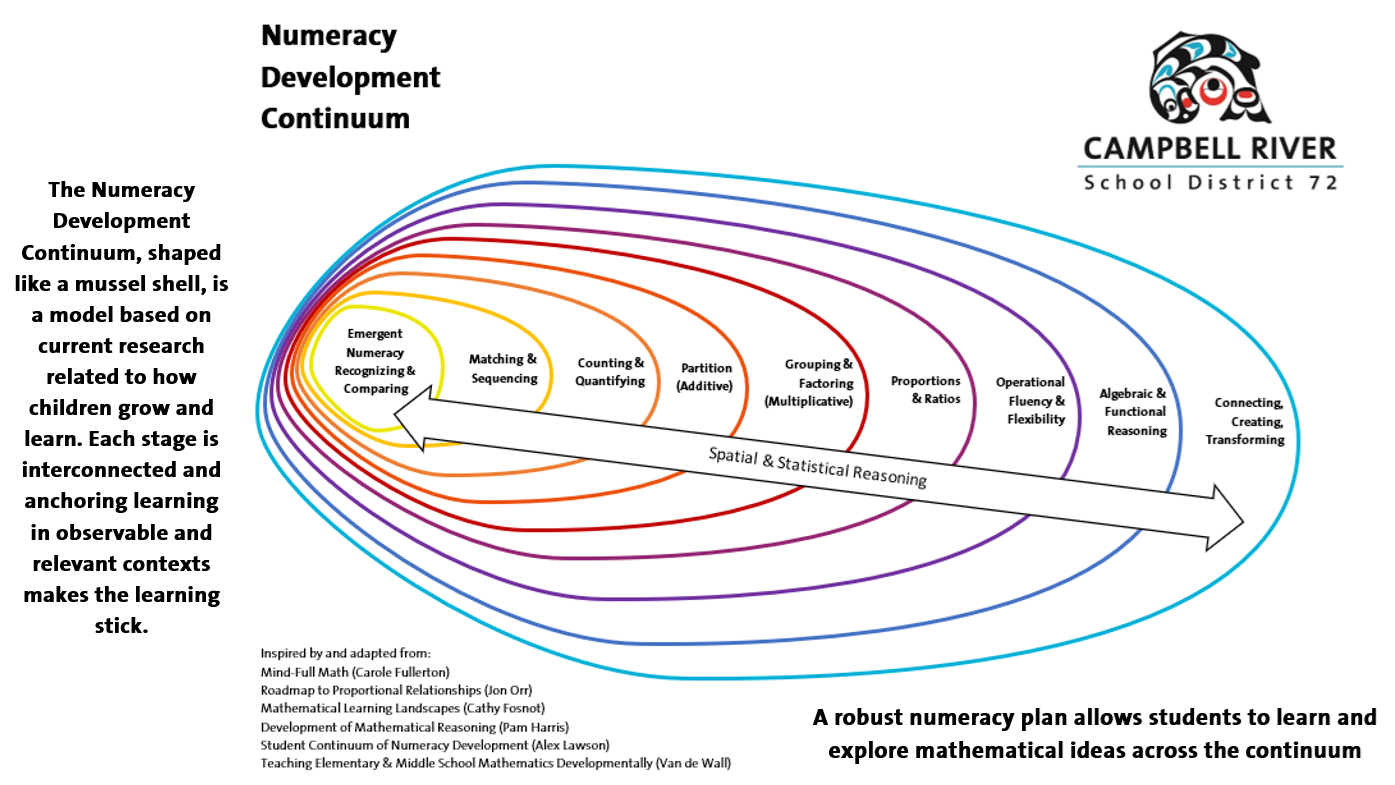
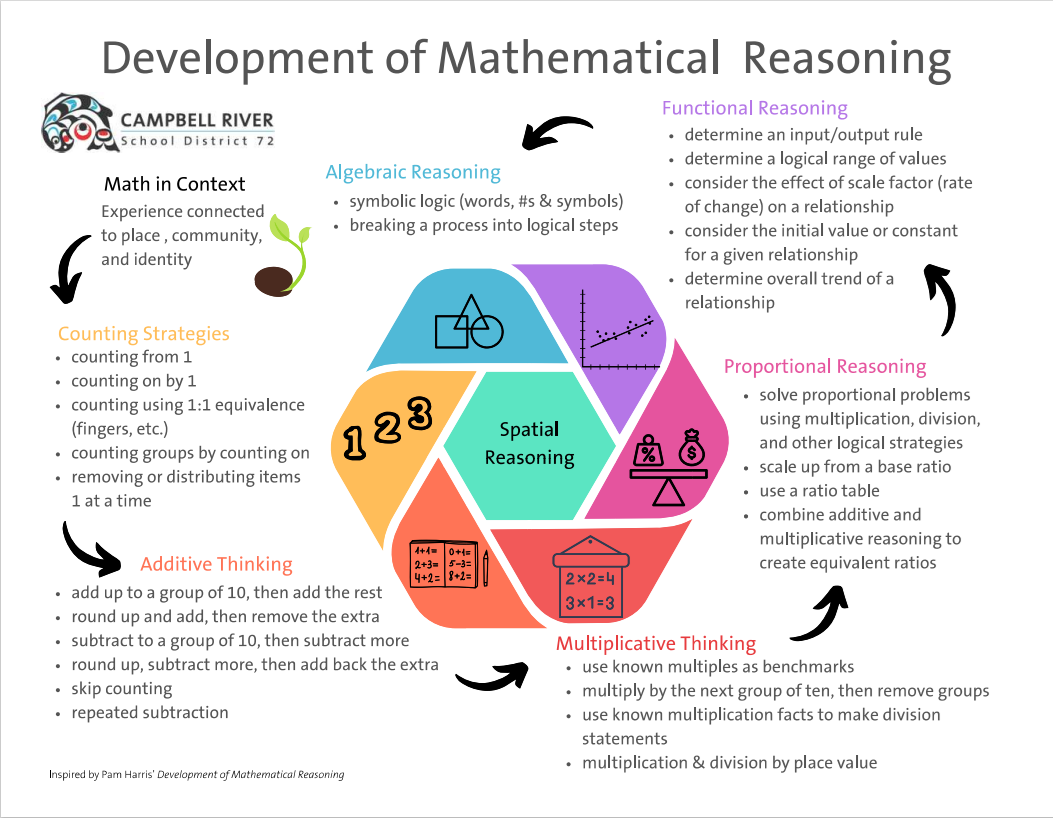
In the table below, you will find instructional resources organized by theme as well as according to discrete skills for Grade 7 Math (ie. Multiples, Ratios, Integers, etc.)
Note: Operational Fluency refers to ease of recognition of which operation is required for a given problem and Computational Fluency (the proficient use of various models and strategies to perform the desired operation)
Brochure with common models and strategies used to develop operational fluency in Grades 6 & 7
| Assessing Proficiency Step by Step Guide: How to Create Analytic Rubrics Using AI How_to_AI_rubric_creation.docx | Sample Analytic Rubric: | Sample Analytic Rubric: | Sample Analytic Rubric: | Self-Reflection Template: |
| Numeracy 7 Year Plan.pdf | Curricular Competencies | |||
| Planning for Proficiency BIG IDEAS K-9 | Understanding & Solving (activate curiosity, play, practice, recall) | Communicating & Representing (use vocabulary, notation & draw visualizations) | Reasoning & Analyzing (Use logic, infer missing information, use & interpret patterns, compare, equate, convert) | Connecting & Reflecting (Consolidate understanding, think creatively, connect ideas, seek challenges) |
| Common Models for Grade 7 |
|
|
| |
| Number Sense | Benchmarks / Estimation
| Communicating Number Concepts
| Reasoning with Numbers
|
|
| Operational Fluency | Four Operations
| Connection to Real-World Contexts | ||
| Measurement (Shape and Space) | Angles and Polygons | Reasoning with Area 3-Act Tasks and Thinking Tasks
| Art Connection | |
| Partitive Reasoning (Decimals, Fractions) |
| Represent decimals and fractions
| Reasoning with Fractions and Decimals Reasoning with Ratio Tables Probability of Independent Events (Experimental and Theoretical) | Financial Literacy Connection
PHE Connection: Assessing Risk |
| Algebraic Reasoning |
|
| Generalize and encode visual patterns as number patterns, then as pattern rules | Digital Literacy Connection: |
| Connecting and Reflecting: Culturally Sustaining Pedagogy | Connecting to Place Exploring West Coast Ecosystems
| Connecting to Language
| Connecting to Culture and Community
|
|
Instructional and Assessment Routines
Formative Assessment
| Proficiency Tables and Concept Maps (Concrete to Abstract)
|
| Learning Through Play |
|

 Google Translate