




5. Check for Understanding: Every Student, Everyday
Information on this page is from: Berger, R., Rugen, L., and Woodfin, L. Leaders of Their Own Learning: Transforming Schools through Student-Engaged Assessment. John-Wiley and Sons.Inc: 2014. |
Checking for understanding with student-engaged assessment strategies helps students reflect on and lead their own learning. Teachers use these strategies so that students understand what they know and can do at the outset of learning and as they progress toward learning targets. Students are able to articulate their understanding and set meaningful goals for applying their learning and improving their work.
A. Starting with learning targets
- Teachers anchor their planning, lessons, and assessments in well-crafted learning targets.
- Teachers gauge student progress against learning targets. They ensure that students know and can articulate where they are in relation to proficiency on academic and character learning targets.
B. Using protocols and engagement strategies
- Teachers use protocols and engagement strategies to ensure that all students participate in whole group discussions (e.g., Cold Call, No Opt Out).
- Teachers engage students actively and equitably (e.g., by using Think-Pair-Share, Back-to-Back and Face-to-Face).
- Teachers use Conversation Cues that promote productive and collaborative discussion (e.g., “Tell me more,” “How is what x said different than what y said?”).
C. Listening and observing strategically
- Teachers circulate while students are working and engaged in structured small-group discussions to observe learning in action (e.g., during the “grapple” portion of a lesson, they listen to determine what students collectively know or can do and to identify common misconceptions).
- During observation, teachers ask open-ended (how? why? what if?) questions that prompt students to extend their thinking.
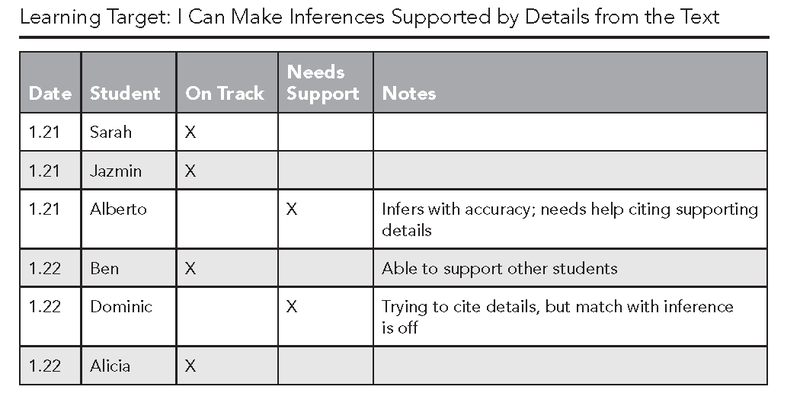
- Teachers sometimes use a checklist to track evidence as they circulate, especially during the “apply” portion of a lesson.
Lesson Plan with Embedded Checks for Understanding
Components of the Lesson | Possible Strategies to Check Understanding |
Engage (Introduction) Students develop curiosity and need to know that is linked to purpose of lesson. |
|
Grapple (Introduction) Students build self-reliance, confidence, and perseverance through grappling with a complex text, problem, or writing skill or concept. |
|
Discuss Students hone their ability to justify their thinking, make coherent arguments based on text evidence, considering the ideas of others. They are metacognititve about their own approaches to math, reading, and writing. |
|
| Focus (Guided Practice) Teachers gradually release responsibility and create a safe space for students to practice the task with support. |
|
| Focus (Mini-Lesson) The teacher provides explicit instruction, focusing on a particular skill or concept and responding to good student ideas, gaps in understanding, and misconceptions. (Note: In same cases, the teacher will choose not to conduct a mini-lesson.) |
|
| Apply (Application) All students have the opportunity to practice the particular skill or concept. |
|
| Synthesize (Share and Debrief) Students return to the learning target, synthesize learning and assess whether or not they have met the target. Teacher and students address misconceptions and generalize conceptual understanding. |
|
D. Using quick-check techniques
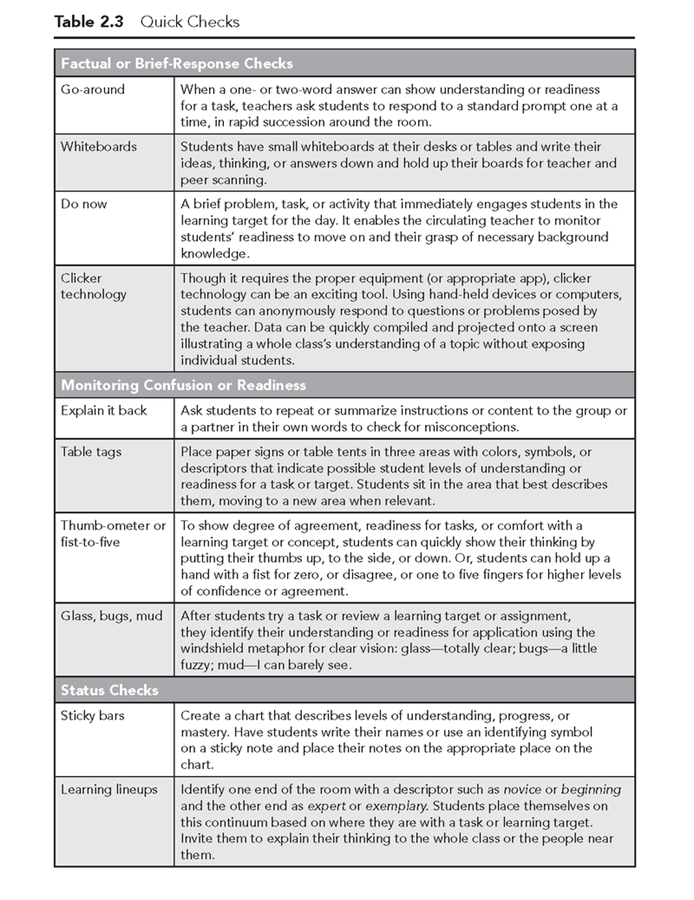
- Teachers use quick-check techniques to engage students in checking their own understanding, to monitor confusion or readiness, to determine the status of the class as a whole, or to probe for deeper understanding (e.g., Go Around, Clickers, Human Bar Graph, Hot Seat).
- Teachers periodically pause instruction or work time to address misconceptions or false starts.
E. Deepening understanding through questioning
- Teachers ask sequenced, pre-planned strategic questions that deepen critical thinking and build students’ understanding of the concept or skill in the lesson.
- Teachers require students to use evidence from the text or data sets to support their answers.
- Teachers help students learn how to formulate their own strategic questions.
- Teachers encourage students to ask questions of themselves and others to monitor and augment their understanding, especially during the discussion portion of a lesson.
- Teachers provide adequate think time so that all students have time to process and construct an answer.
F. Self-assessing, reflecting on progress, and setting goals
- Teachers use models and critique sessions to help students develop an understanding of quality in texts and in their own product creations and to set goals for progress.
- Teachers provide descriptive feedback and facilitate peer feedback sessions that enable students to reflect, self-assess, and set goals for revision.
Opportunities to check for understanding


 Google Translate