




3. Co-Create Success Criteria
Success criteria answer an important questi on for the student:
Defining strong criteria for success
To be useful, success criteria must:
- relate to the learning target
- be visible, observable, measurable
- be understandable to students
- describe what it means to do good work in today's lesson
- fit the performance of understanding
- make effective teaching and meaningful learning visible
Using exemplars to co-construct success criteria with students
"How do you know when you have learned something?"
"Do you think you can tell what the goal of the assignment is from this exemplar?"
"What am I learning?" or "What am I going to learn?"
"How will I know that I've learned it?"
Nuances of success, levels of proficiency
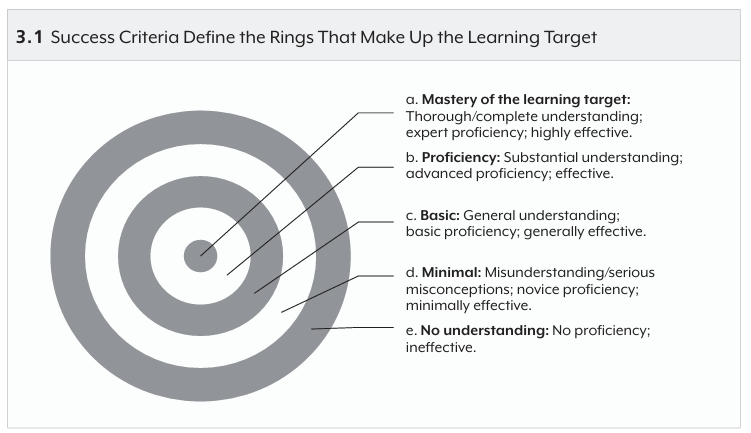 -Moss, C. M., & Brookhart, S. M. (2012). Learning targets: Helping students aim for understanding in today's lesson. ASCD.
Students cannot become sharp shooters until they are able to discern the levels in quality that differentiate hitting the bull’s‑eye dead center from hitting one of the target’s outer rings. To hit the bull’s eye, students need strong criteria for success—a set of student look‑fors—to use during the formative learning cycle.
To make a rubric, creating definitions with concrete, measurable, and student-friendly language, of each ring of the bull's-eye, as it relates to the specific learning target.
Key attributes of high quality work
Complexity
- Complex work is rigorous: it aligns with or exceeds the expectations defined by grade-level standards and includes higher-order thinking by challenging students to apply, analyze, evaluate, and create during daily instruction and throughout longer projects.
- Complex work often connects to the big concepts that undergird disciplines or unite disciplines.
- Complex work prioritizes transfer of understanding to new contexts.
- Complex work prioritizes consideration of multiple perspectives.
- Complex work may incorporate students’ application of higher order literacy skills through the use of complex text and evidence-based writing and speaking.
Craftsmanship
- Well-crafted work is done with care and precision. Craftsmanship requires attention to accuracy, detail, and beauty.
- In every discipline and domain, well-crafted work should be beautiful work in conception and execution. In short tasks or early drafts of work, craftsmanship may be present primarily in thoughtful ideas, but not in polished presentation; for long-term projects, craftsmanship requires perseverance to refine work in conception, conventions, and presentation, typically through multiple drafts or rehearsals with critique from others.
Authenticity
- Authentic work demonstrates the original, creative thinking of students—authentic personal voice and ideas—rather than simply showing that students can follow directions or fill in the blanks.
- Authentic work often uses formats and standards from the professional world, rather than artificial school formats (e.g., students create a book review for a local newspaper instead of a book report for the teacher).
- Authentic work often connects academic standards with real-world issues, controversies, and local people and places.
- Authenticity gives purpose to work; the work matters to students and ideally contributes to a larger community as well. When possible, it is created for and shared with an audience beyond the classroom.
References
Berger, R., Rugen, L., & Woodfin, L. (2014). Leaders of their own learning: Transforming schools through student-engaged assessment. Jossey-Bass.
Moss, C. M., & Brookhart, S. M. (2012). Learning targets: Helping students aim for understanding in today's lesson. ASCD.


 Google Translate