




9. Reflect & Self-Assess
| “When students self‑assess, they internalize standards and assume greater responsibility for their own learning." -Darling‑Hammond et al., 2008 |
The Big 3: a framework for student self-assessment
The three fundamental learning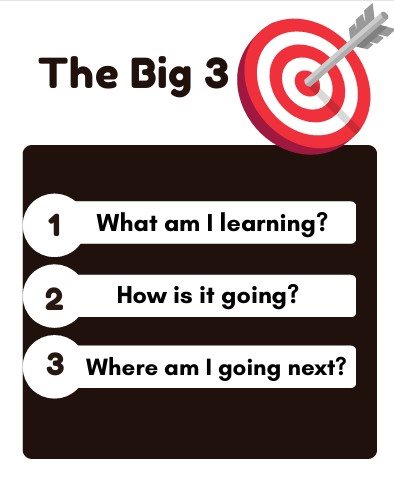 questions guide teachers in planning/curricular mapping, instruction, assessment, and reporting, but their real power is in their use with students. The Big 3 are the litmus test of the teacher-student partnership: if students can answer each question, using the previous eight student-engaged instruction and assessment practices, then they are true partners and drivers of their own learning.
1. What am I learning?
2. How is it going?
3. Where am I going next?
| "To engage in learning, students need answers to the three central questions of the formative assessment process: Where am I going? Where am I now? How can I close the gap between where I am now and where I want to go? Learning targets are the key to developing assessment-capable students—that is, students who regulate their own learning by answering these three questions as they work. It’s the teacher’s job to increase the skill (the ability to self‑assess) and the will (the disposition to self‑assess) of the most important data‑driven decision makers of all: the students" Brookhart, S. M., & Moss, C. M. (2014). Learning targets: Helping students aim for understanding in today’s lesson. ASCD. |
The Formative Learning Cycle
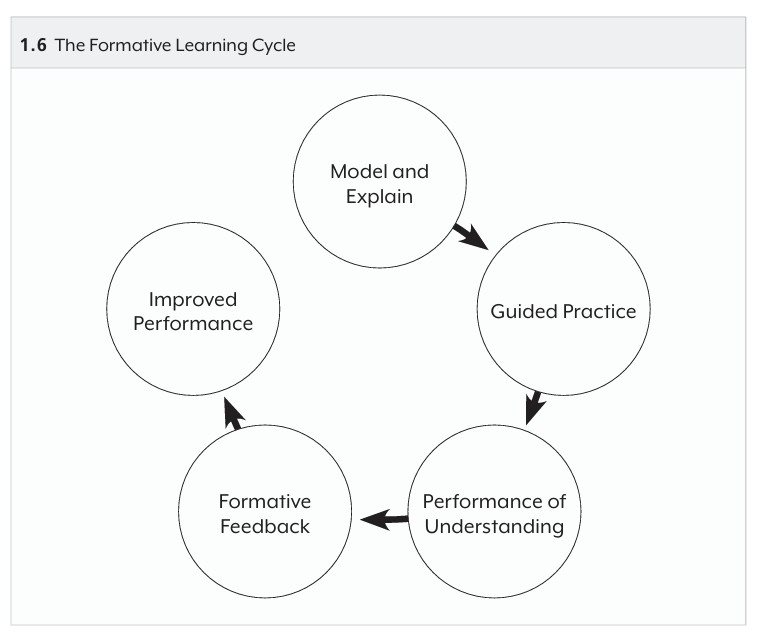 Brookhart, S. M., & Moss, C. M. (2014). Learning targets: Helping students aim for understanding in today’s lesson. ASCD.
A formative learning cycle embodies the following research‑based factors that improve student learning and achievement:
- Learning targets and success criteria;
- A classroom learning team;
- Consistent, targeted feedback that feeds learning forward;
- A built‑in chance for students to use feedback to improve their work;
- Goal‑setting and goal‑getting opportunities that promote self‑regulation and self‑assessment; and
- The formative assessment process.
A formative learning cycle goes hand in hand with formative assessment, which we define as “an active and intentional learning process that partners the teacher and the students to continuously and systematically gather evidence of learning with the express goal of improving student achievement” (Moss & Brookhart, 2009, p. 6).
Align subject-specific & Core Competency goals
Every reflection can be a Core Competency reflection. If we regularly connect our subject-specific learning standards & targets with a single Core Competency facet, students will better understand both.
| Subject-Specific Learning Standard (competency + content) | Core Competency & Facet | Aligned or Layered Goal for Student Reflection |
| PHE 3 - "Develop and demonstrate safety, fair play, and leadership" in "different types of physical activities" | Personal Social - Contributing to Community & Caring for the Environment "Students develop awareness of and take responsibility for their school environments by working independently and collaboratively for the benefit of others, the class community, and the learning & physical environment." | "I showed that I can take care of my school and help others. I help put away equipment after activities so the gym stayed safe and tidy. I also follow rules when working with others and I listen to my classmates during group games. When someone needs help, I work with them or showed them what to do. I try to make our class and school environment a good place for everyone." |
| Social Studies 7 - "Assess the significance of different factors" (events, features, etc.) that "contributed to the rise and fall of civilizations" (significance) | Critical Thinking - Analyze & Critique "make defensible judgments or assessments, and draw conclusions" | "I can make a defensible judgement about historical events. I showed I can do this when I argued about the significance of Rome's enormous geographical size in its power and, ultimately, its fall. In my project/essay/ presentation on Rome....." |
| Physics 11 - "Communicate scientific ideas and information about the conservation of energy, using appropriate scientific language, conventions, and representations" | Communicating - Acquiring & Presenting Information "they make strategic choices to help convey their messages and create their intended impact." | "I showed how potential energy is converted into kinetic energy by using an area chart to illustrate the different forms of energy in a system. The chart demonstrates that while energy changes from one form to another, the total amount of energy remains constant, demonstrating the law of conservation of energy." |
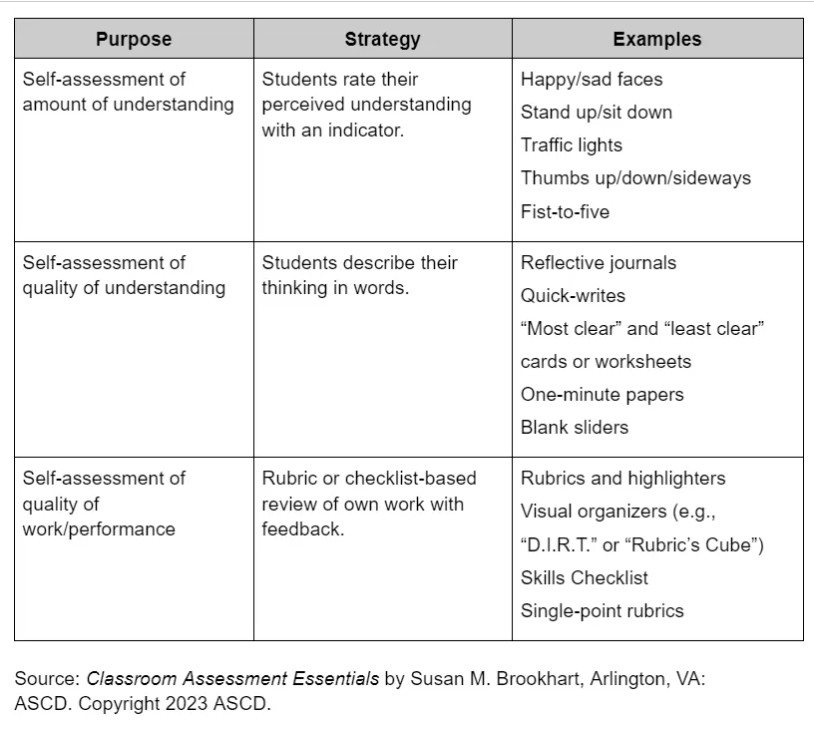
Strategies for self-assessment
Harness Peer with Protocols
Tuning and Critique Protocols allow teachers to harness peers for feedback. But peer assessment is not just about eliciting more feedback from more people; it's another way to foster in every student a deeper understanding of the learning goals and success criteria.
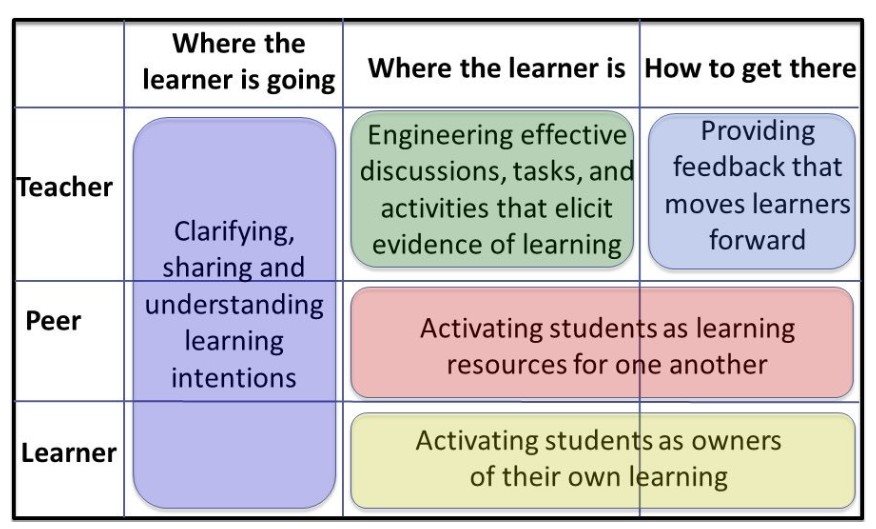 Wiliam, D. (2011). Embedded formative assessment. Solution Tree Press.
Critique Protocol/Lesson
Use critique as a lesson to surface what students know about high-quality work and to determine success criteria, which helps students to better understand the learning goals.
Critique or Tuning Protocol - Guidelines for K-12 Students
When implementing a tuning protocol with students, a clear set of structural guidelines ensures a safe and effective environment:
- Establish Ground Rules:
- Set critique norms (e.g., "be kind, specific, and helpful" rather than judgmental).
- Determine what each critique norm looks like and sounds like – co-create norms with students using a T-Chart
- Feedback must be descriptive and constructive, not just blanket praise or harsh criticism. It should generate ideas for how to improve by better meeting the learning goals.
- Set Time Limits: Keep steps strictly timed to maintain focus, build pacing, and prevent the feedback from becoming overwhelming.
- The Presenter is Silent: During the critique phases, the presenting student turns their back or remains quiet so they can process the feedback without feeling defensive.
The 7-Step Peer Assessment Process
This protocol typically takes about 30-40 minutes and follows a prescribed path:
- Project Overview (3-5 minutes): The presenting student (or team) shares their work, the learning standard or target they are trying to achieve, and a specific "focusing question" for the feedback, such as, “how could we better show our competency with the learning target?” or “what are the strengths of our work in relation to the learning target?” or questions that use the learning target vocabulary or reword the target as a question.
- Clarifying Questions (2-3 minutes): Peers ask quick, factual questions to understand the basics of the project (e.g., “What is your main topic?” “What is the key competency you’re showing?). No critique is allowed yet.
- Assessment & Reflection (2 minutes): The peer group silently reviews the project and prepares their feedback against the assignment's learning target, criteria, and/or rubric.
- "I Like" / Warm Feedback (5 minutes): Peers take turns sharing specific, positive aspects of the project and how it aligns with the stated goals.
- "I Wonder" / Cool Feedback (5-10 minutes): Peers pose constructive questions starting with “I wonder…” to gently point out areas for improvement in aligning with the stated goals, without dictating exactly what the presenter must do.
- Presenter Reflection (3-5 minutes): The presenter speaks aloud to the feedback, noting what resonated with them and brainstorming their next steps.
- Group Debrief (3 minutes): The whole group reflects on the effectiveness of the process itself.
See the different protocol guidelines below.


 Google Translate