




4. Design & Deliver Instruction
Evidence-based instruction practices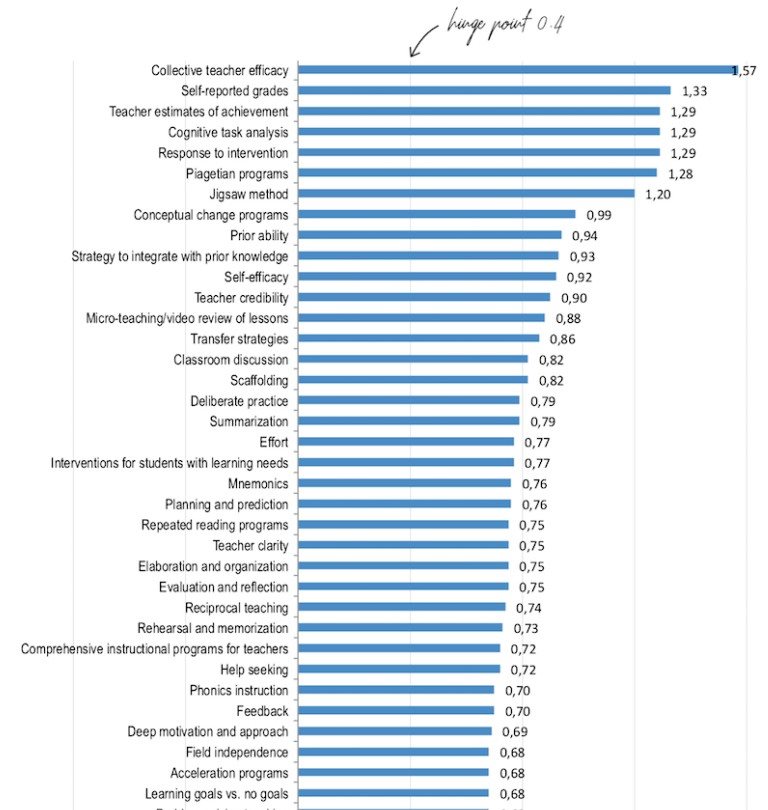
Hattie Ranking: 252 Influences And Effect Sizes Related To Student Achievement
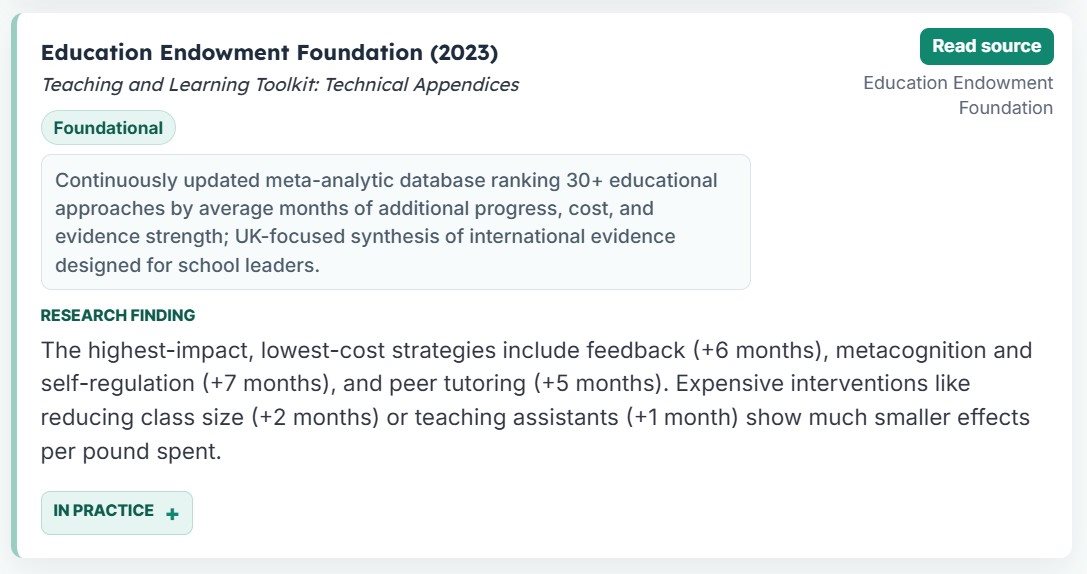
Some of the most popular study strategies among learners are among the least effective, according to research findings by Dunlosky, et al in 2013*. Rawson, Marsh, Nathan, & Willingham in 2013. Research has also found that some popular teaching strategies do not significantly enhance student learning. John Hattie's Visible Learning work synthesizes extensive research to identify teaching strategies--and other factors related to the student, the classroom, and the teacher--that make learning visible to teachers and learners and have the biggest impact on student achievement.
Visible Learning focuses on how teaching strategies impact learning. It asks us to rethink planning and instruction, and to move from traditional, teacher-focused ideas of "covering curriculum" and what to teach, to student-centered ideas about what students will learn and how the teacher will get them there. The 4 goals of VL, which have "The Big 3" embedded in them, are for both teacher and students to know:
- where students are - "Right now, I can (verb)..."
- where they are going / what they are learning - "I am learning to (verb)..." or "My goal is to be able to (verb)..."
- how they will know that students have learned it - "I will know that I've learned it when I see/can do/hear...."
- how learners will get there - "My next step is to....by doing..."
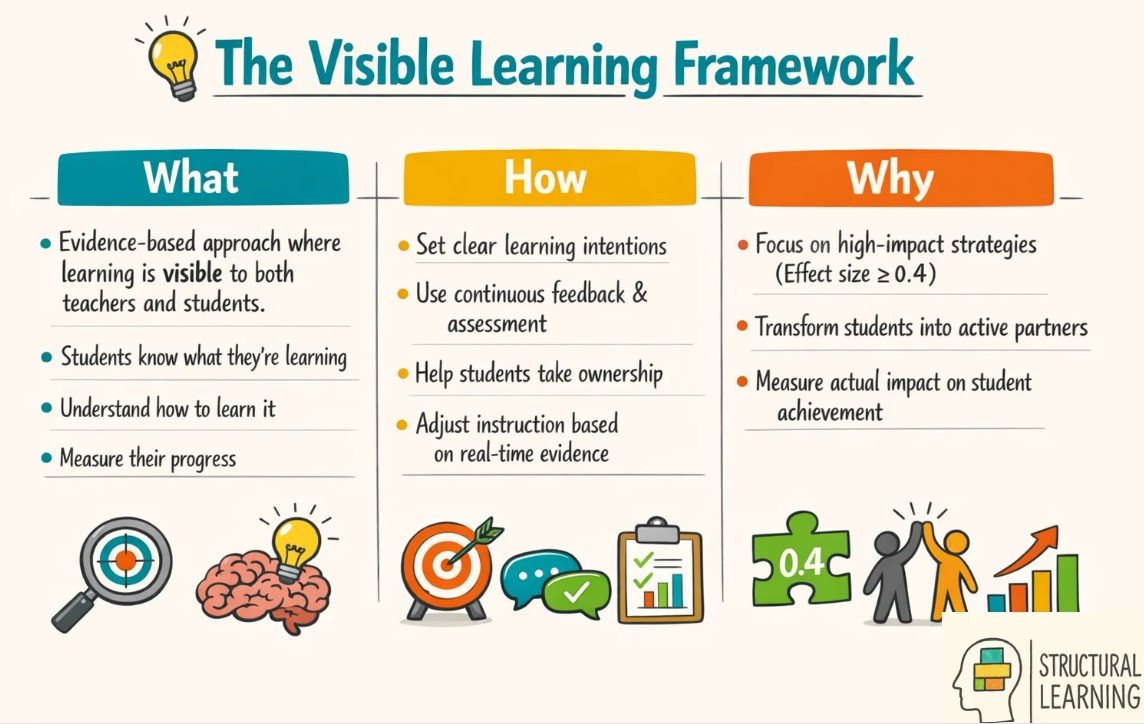
Visible Learning prompts us to:
- make learning goals and success criteria explicit
- use formative assessment data and academic research to make instructional decisions
- continually ask, "what is the impact of my teaching (these instructional strategies) on student learning?"
Student-engaged instruction
Student-engaged instruction models update traditional models by flipping the sequence to prioritize productive struggle over passive listening.
Components of a student-engaged lesson |
Engage (Introduction) Students develop curiosity and "need-to-know" that is linked to the purpose of the lesson. Teacher introduces a question, problem, artefact, mystery, etc. |
Grapple (Introduction) Students build self-reliance, confidence, and perseverance through grappling with a complex text, problem, or writing skill or concept. |
Discuss Students hone their ability to justify their thinking, make coherent arguments based on text evidence, considering the ideas of others. They are metacognitive about their own approaches to math, reading, and writing. |
Focus (Guided Practice) Teachers gradually release responsibility and create a safe space for students to practice the task with support. |
Focus (Mini-Lesson) The teacher provides explicit instruction, focusing on a particular skill or concept and responding to good student ideas, gaps in understanding, and misconceptions. (Note: In same cases, the teacher will choose not to conduct a mini-lesson.) |
Apply (Application) All students have the opportunity to practice the particular skill or concept. |
Synthesize (Share and Debrief) Students return to the learning target, synthesize learning and assess whether or not they have met the target. Teacher and students address misconceptions and generalize conceptual understanding. |
from Berger, R., Rugen, L., and Woodfin, L. (2014) Leaders of Their Own Learning: Transforming Schools through Student-Engaged Assessment. John Wiley and Sons, Inc. p. 80. |
Watch this class during the "Grappling" part of the lesson:
Lesson Format
Teachers choose specific lesson formats for specific purposes. When using more passive teaching practices like lectures or video screenings, teachers can embed "activating" strategies like graphic organizers, midsession questioning or critique, and pair-shares to engage learners.
- When students are learning content or practicing and mastering foundational facts, video, lectures, or memorization games may be appropriate.
- When students are applying knowledge and skills to tasks, products, or performances, extended work sessions and labs may best serve the purpose.
Make time for debrief and reflection
Visible-Thinking reflection prompt / sentence stem: "I am learning to...I'll know I can do it when I...Right now, I can..., so my next step is to..." |
Research continues to find that whole-class debriefs of the daily learning and individual reflection are highly effective contributors to student learning and achievement - especially when the teacher ensures that both connect back to daily lesson's learning target.
References
Berger, R., Rugen, L., and Woodfin, L. (2014) Leaders of Their Own Learning: Transforming Schools through Student-Engaged Assessment. John Wiley and Sons, Inc.
Hattie, J. (2009). Visible learning: A synthesis of over 800 meta-analyses relating to achievement. Routledge.


 Google Translate