




2. Develop Learning Targets
| "improving the teaching-learning process requires everyone in the school—teachers, students, and administrators—to have specific learning targets and look-fors. Observing isn’t the same as seeing. Our own research convinces us that educators do not describe what they see during a classroom observation; rather, they see what they can describe (Brookhart et al., 2011; Moss, 2002). For example, a principal who does not understand the characteristics of a performance of understanding can observe 1,000 lessons and never distinguish lessons that have one from lessons that do not. Our theory of action urges students, teachers, principals, and central‑office administrators to look for and learn from what effective instruction and meaningful learning look like." Brookhart, S. M., & Moss, C. M. (2014). Learning targets: Helping students aim for understanding in today’s lesson. ASCD. |
What is a learning target?
Learning targets are the small, sequenced, daily learning goals that comprise the long-term goal that is the learning standard. The scope and sequence of these learning targets for one learning standard is called a learning progression. Learning targets:
- make the lesson's learning explicit for the student and teacher
- include the knowledge (facts, concepts, content) and skills (competencies) of the standard
- always include at least one noun (knowledge) and one verb (skill)
- match the depth and rigor of the learning standard
- are specific and measurable, using observable verbs
- increase in complexity, like a sequence of steps toward mastery
- are task neutral (students can show competency via different tasks or activities).
- allow students to see and track their own progress
- make learning visible for teachers, students, and guardians
- give laser-like focus, intention, and purpose to each lesson in the learning progression
What a learning target is NOT
A learning target centers on what is to be learned and how students will show that they've learned it. It should never focus on a task or on what will be completed.
no: "Students will be able to write a paragraph." or "I can complete a paragraph."
yes: "Students will organize information appropriately for the medium." or "I can use a narrative structure to organize information."
Teachers talk about how to unpack learning standards with students:
Learning targets are the "raison d'être" for today's lesson
A learning target is good for only one lesson, describes the lesson’s unique learning intention, and answers the question, "Why are we asking our students to learn this chunk of content in this way on this day?"
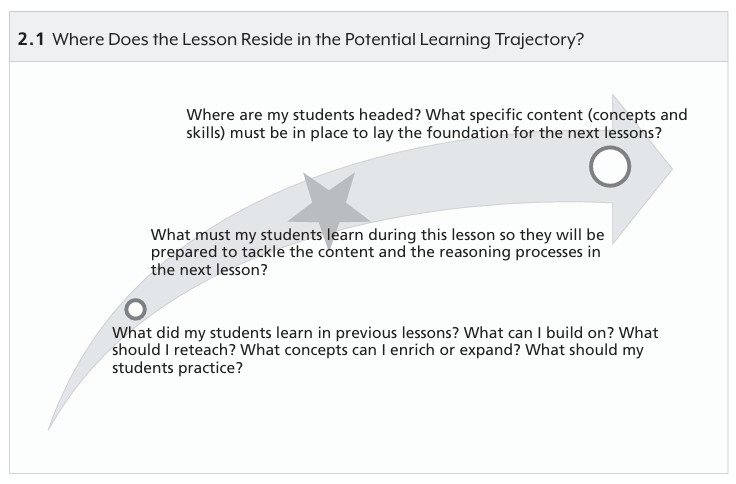 Connie M. Moss and Susan M. Brookhart. Learning Targets: Helping Students Aim for Understanding in Today’s Lesson. ASCD: 2012.
For example, the purpose of the lesson might be to:
• Introduce a new concept or skill (e.g., “Describe the characteristics of the solar system”);
• Examine a specific part of a concept or skill (e.g., “Compare and contrast the characteristics of the planets”);
• Put learned parts of a process together to form a more sophisticated concept or skill (e.g., “Explain the role of gravity in the workings of the solar system”);
• Apply a learned concept in a new context (e.g., “Use 21st century knowledge to critique the ideas of Ptolemy, Aristotle, Copernicus, and Galileo about the solar system”);
• Build on a shallow concept to deepen it (e.g., “Demonstrate and explain how the Earth’s axial tilt causes the seasons”);
• Reteach a concept to clear up points of confusion (e.g., “Sort out and clarify misunderstandings that occur when we apply the terms revolution and rotation to relative movements of planets and moons”);
• Close gaps in understanding (e.g., “Describe how the tilt of the Earth causes the summer season to occur in a specific hemisphere while understanding that the hemisphere tilted toward the sun will experience summer not because it is closer to the sun than the other hemisphere”);
• Extend learning about a concept (e.g., “Describe how asteroids and comets fit into the solar system and the characteristics that distinguish them from one another”).
The crucial questions become:
• What did students learn in yesterday’s lesson?
• How well did they learn it?
• Where are they confused?
• What can they use meaningfully?
• Where is their learning heading in upcoming lessons
A lesson should never ask students to do more of the same. Each lesson should have a specific purpose—a reason to live.
How to write learning targets
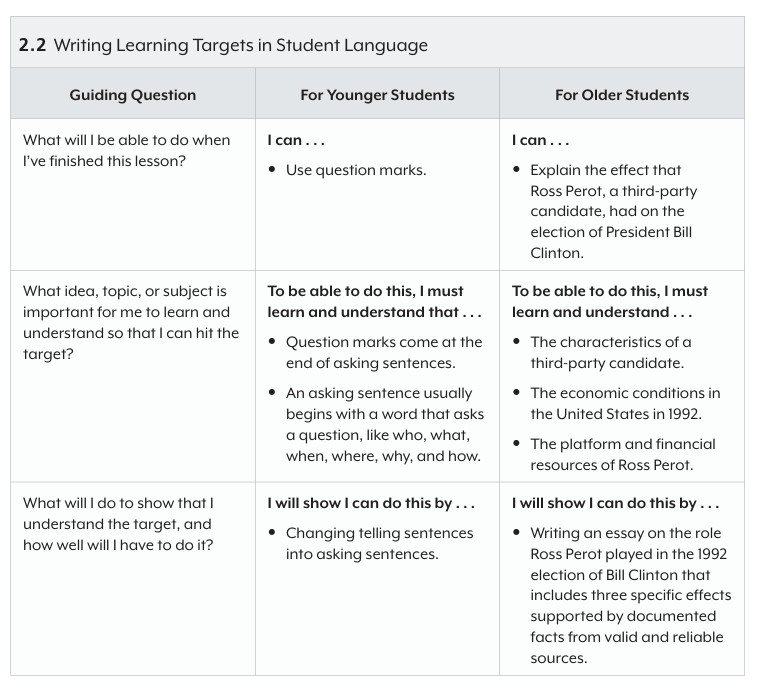 Connie M. Moss and Susan M. Brookhart. Learning Targets: Helping Students Aim for Understanding in Today’s Lesson. ASCD: 2012.
Examples in daily lessons
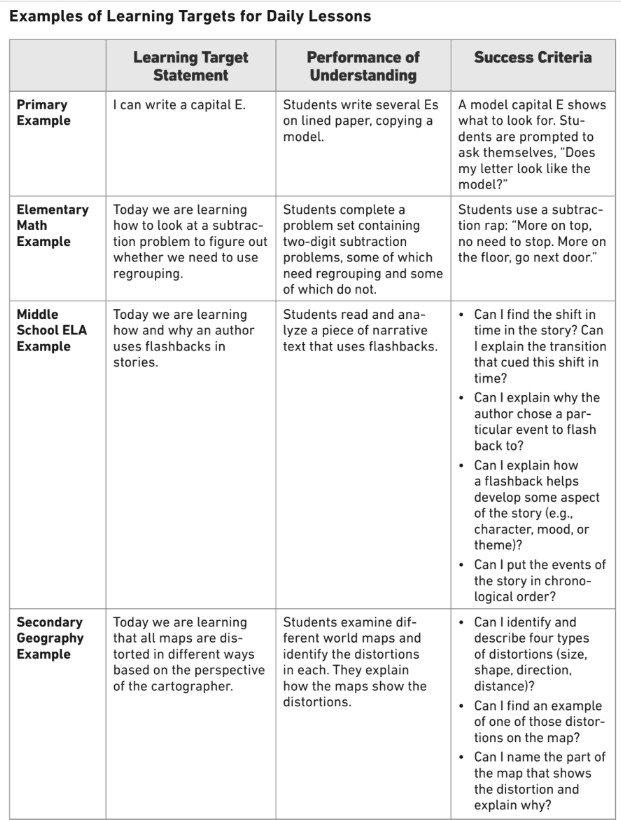 Brookhart, S. M. (2015). Classroom assessment essentials. Association for Supervision and Assessment Development.
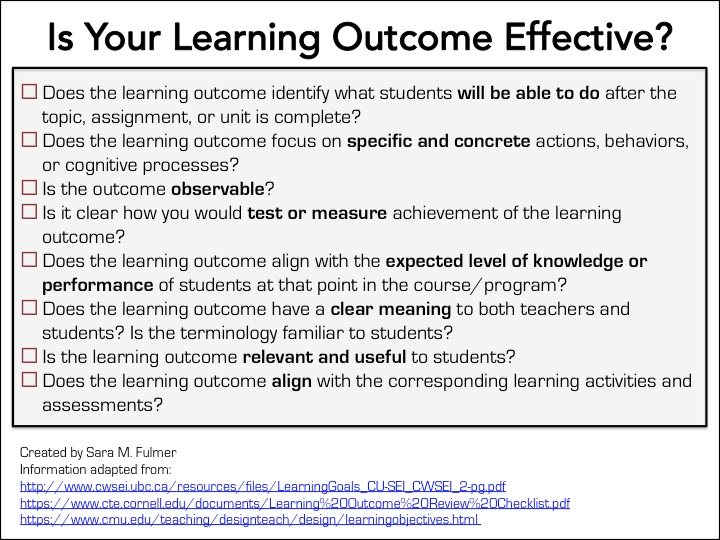
References
Berger, R., Rugen, L., & Woodfin, L. (2014). Leaders of their own learning: Transforming schools through student-engaged assessment. Jossey-Bass.
Brookhart, S. M. (2015). Classroom assessment essentials. Association for Supervision and Assessment Development.
Moss, C. M., & Brookhart, S. M. (2012). Learning targets: Helping students aim for understanding in today's lesson. ASCD.


 Google Translate