




8. Feed Back, Up, & Forward
Effective feedback more strongly and consistently raises student achievement than any other teaching behavior (Hattie, 2009). It provides students with “just‑in‑time, just for‑me information delivered when and where it can do the most good” (Brookhart, 2008, p. 1), and it answers the three central questions of the formative assessment process from the student’s point of view:
Moss, C. M., & Brookhart, S. M. (2012). Learning targets: Helping students aim for understanding in today's lesson. ASCD. |
| Effective feedback answers "The Big Three": Where am I going? (Feed up) | 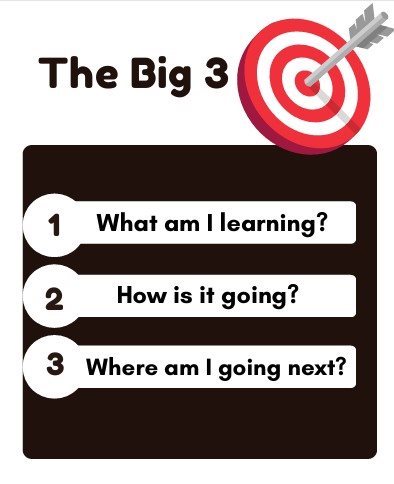 |
Effective feedback feeds up and forward
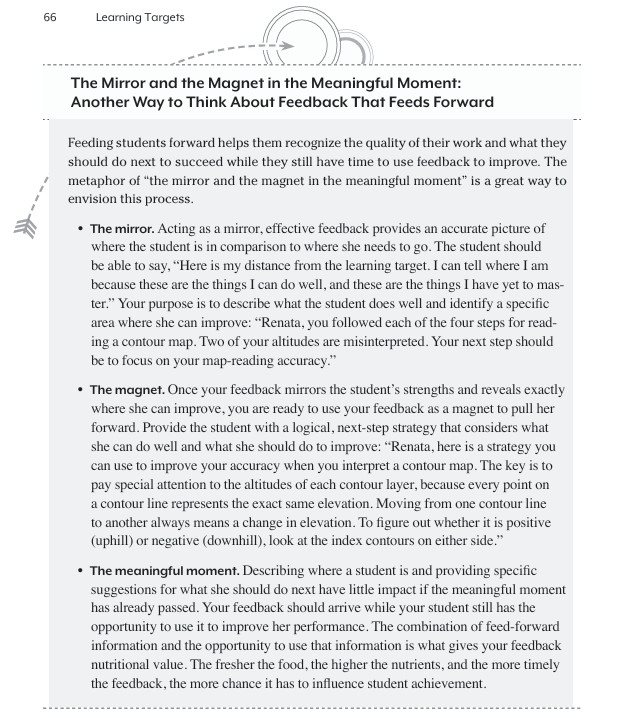
Effective feedback is nonjudgmental, positive, and descriptive. It arrives while students are learning so that they can use it to improve their work (Brookhart, 2008; Moss & Brookhart, 2009). Feedback that feeds forward shares five characteristics:
- It focuses on success criteria from the learning target for today’s lesson. (feed up)
- It describes exactly where the student is in relationship to the criteria. (feed back)
- It provides a next‑step strategy that the student should use to improve or learn more. (feed forward)
- It arrives when the student has the opportunity to use it.
- It is delivered in just the right amount—not so much that it overwhelms, but not so little that it stops short of a useful explanation or suggestion.
Effective feedback as coaching
Video: Descriptive Feedback Helps All Students Reach Proficiency
Video: Models, Critique, and Descriptive Feedback
Sample questions for students to consider as they watch:
- How did Austin improve his drawing?
- Describe the qualities of the feedback that helped Austin improve.
- Can you recall an experience in which formative assessment led directly to your improvement in some skill? What aspects of the assessment were most powerful or effective in your growth?
- Identify at least three ways that formative assessment in the video is similar to how athletes learn or are coached in sport.
- Consider a basketball team where the coach uses traditional classroom assessment. The coach gives feedback in the form of numbers, such as proportions or percentages. Do you think players would improve more quickly? Explain.
- Create a Venn Diagram to compare and contrast traditional assessment and coaching.
- How can teachers make formative assessment more like coaching?
- What are the barriers to doing so? What are the potential benefits?
Planning for effective feedback
How much of your day or week do you spend giving feedback? How much of your feedback is actually used?
Research -- by Susan Brookhart in 2008 and others since then -- highlights these key factors in the efficacy of feedback:
- the nature of the feedback
- the context in which the feedback is given
- the mindsets of students
Brookhart and others have found that feedback is most likely to be used by students to improve their learning when:
- students know the learning target and have set goals for their learning
- they are taught the language and norms of critique
- they are shown positive models of giving and receiving feedback
- they have time and opportunity to use it.
Creating the conditions for feedback to be used by students
1. Students know the learning target and have set goals for their learning.
- Start a routine of introducing the learning target and assessing student learning each day in one course.
- Write the learning target on the board when it's appropriate in the lesson. It doesn't have to be at the beginning; we shouldn't part with a great hook or dull the magic of teaching and learning with formulaic moves. Telling students what the purpose of this lesson is (or better yet, creating a hook through which students discover it) brings intention and laser focus to it, allowing teachers to let go of activities and assessments that don't advance the goal.
- Assess and track students' progress in grasping daily learning targets using a class list like the roster below. Have students do a quick write or ticket out the door to see which students grasp the target.
- Position students as co-owners and agents of learning by having them keep track of their own progress. Corwin's examples below, in the document "Students Self-Assess and Track Learning.pdf", offers ideas of what teachers could provide to facilitate this.
2. Students are taught the language and norms of critique.
- At some point in the unit, provide guided, collaborative critique sessions that introduce students to strong models of work (in various tasks or formats) showing extending levels of proficiency and making aspects of quality visible.
- Create a task-neutral, proficiency-based rubric for the competency you are focusing on. Think carefully about the rubric categories, or aspects of quality students need to address. Use AI for help.
- Use AI to create exemplar(s), based on your rubric, showing at least a proficient level of student grasp on the competency. Providing students with evidence of learning that is in different forms (written words, symbols like pictures or equations) or activities (diorama, poster, poem, video, etc.), will help them focus on what understanding looks like instead of what a nice product looks like.
- Provide students with the rubric and the models/exemplars. Ask students to examine the model(s) of work and "mark" them using the rubric. Students should highlight descriptors for each aspect of quality for every work sample.
- In groups no larger than 4, have students discuss and come to consensus on what level of proficiency each model shows in each aspect of quality, referring directly to the rubric.
- As a class, debrief findings, ensuring that all the components of the rubric have been addressed and understood:
- all aspects of quality
- the meaning of each proficiency level
- domain-specific vocabulary
- Don't end discussion before the class has developed the precision in language needed to understand the criteria well enough to meet it in their own work. This precision means they have identified domain-specific vocabulary (voice) that is key to high quality, built concrete language to describe varying degrees of proficiency (unique, brief, effective) in each aspect of quality (voice), and referred to specific strategies (using unique verbs, brief dialogue) that produce high quality. For example: students should be able to say that the exemplar "uses unique verbs instead of 'said' and brief dialogue to establish effective voice" instead of "it has flow" or that "the voice is good."
- As a class, discuss overall findings, with particular attention paid to matching students' language with the academic vocabulary on the rubic. This helps student to internalize a shared understanding of criteria and proficiency, and to develop the language needed to discuss both of these and to understands the teachers' feedback.
- See the "Tuning Protocol" and Giving and "Receiving Peer Feedback" documents below.
3. Students are shown positive models of giving and receiving feedback.
- Normalize the giving and receiving of feedback as essential for learning. Giving feedback helps students to hone their understanding of the descriptors on a rubric, bridging the abstract language on rubrics with the concrete expression in sample work. Receiving feedback helps them to understand that learning is fundamentally social and relational.
- Invite students to reflect on their experiences with feedback, to surface any ideas of it being critical or negative.
- Invite students to recall times where feedback has helped them improve at something. Ask them what characteristics or conditions made the feedback useful, and have these conditions govern the giving of feedback in class.
- Help students to reframe feedback by giving back student agency through: Inviting students to ask you as the teacher what to provide feedback on in their work; Providing feedback on these and inviting the student to name others.
- Help students to give feedback that their peers can "hear" by collaboratively generating a list of language and words and qualities that students find positive and uplifting as opposed to critical and insulting. Keep the list visible in the classroom and ensure your class lives by the language. Add your own sentence starters if students miss anything.
- Make feedback a part of class culture by inviting students as a class and individually, to give you feedback too. Model receiving feedback by giving students surveys about yesterday's lesson, for example, that you can improve on.
Feedback is often most effective when:
1. students are given the opportunity to use it.
2. it is given verbally while students are working - and you have asked the student to repeat it back to you.
3. it is focused on priority points related to the learning target.
4. it is given often and is ongoing.
5. it is focused on the process of learning/assessment, the ability of the student to self-regulate during work/assessment, or the thought processes needed to accomplish the task that will become the student's evidence of learning--all of which need to be related to the learning target and success criteria for the learning target.
6. the student has the mindset to hear and act on it, meaning they don't see intelligence or academic success as fixed, but as something that comes from effort, practice, and improving one's skill by using instruction and taking feedback. In other words, the student has a growth mindset.
7. The teacher has a good relationship with the student.
8. The teacher understands the student, has strong knowledge of where the student is and what they can and cannot yet do, knows where the student's zone of proximal development is, and provides feedback at exactly the level of challenge, but not frustration.
References
Berger, R., Rugen, L., & Woodfin, L. (2014). Leaders of their own learning: Transforming schools through student-engaged assessment. Jossey-Bass.
Moss, C. M., & Brookhart, S. M. (2012). Learning targets: Helping students aim for understanding in today's lesson. ASCD.


 Google Translate