




The Big 3 & Student-Engaged Instruction and Assessment
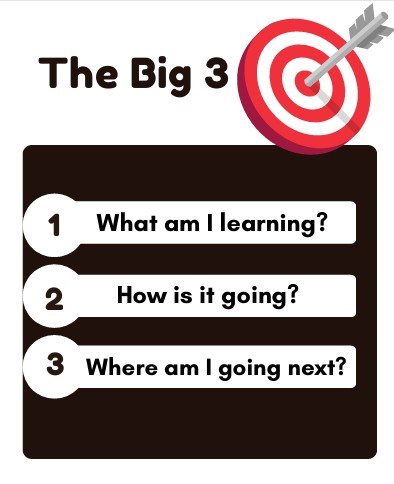 See below for printable poster
The Big 3: The foundations of student-engaged instruction and assessment
In 2007, John Hattie and Helen Timperley introduced three fundamental learning questions to use with students and drive student-centered teaching and learning:
1. What am I learning?
2. How is it going?
3. Where am I going next?
Six factors that allow students to drive their learning*
1. Students know their current level of knowledge, understanding, and skill.
2. They know where they are going (learning targets & success criteria) and that the goal is achievable. (What am I learning?)
3. Students have choice; they can select the tools to guide and show their learning.
4. They seek feedback and recognize that errors are opportunities to learn. They know what to do when they don't know what to do. (How is it going? Where am I going next?)
5. They monitor their progress and adjust behavior related to learning.
6. Students recognize their learning.
*Fischer D., Frey N., Ortega S., Hattie J. Teaching Students to Drive Their Learning, 2023
Evidence-based practices that foster student-engaged instruction and assessment
Student-engaged instruction and assessment involves the following evidence-based practices, which foster the six factors above throughout the learning cycle.
1. Prioritize learning standards to teach explicitly; don't cover all of the Curricular Competencies.
2. Develop learning targets by unpacking the standard. (What am I learning?)
3. Co-create success criteria for the standard and/or daily learning targets. Use models or exemplars to identify aspects of quality. (What am I learning? (more specifically))
4. Design and deliver instruction.
5. Check for understanding - every lesson, every student. (How is it going?)
6. Facilitate guided practice. Catch and release as needed: gather students to correct misconceptions or reteach a concept or skill; then let them return to correctly practice the work.
7. Perform understanding: create assessment methods that align with the overall learning standard or smaller targets, having students perform or do the skill with the content knowledge in the goal.
8. Provide and have students use feedback to close the gap between where students are and where they are going. (Where am I going next?)
9. Reflect and self-assess. Teach students to make sense of scores, monitor their progress, identify strengths and challenges, and set goals. (What am I learning? How is it going? Where am I going next?)
Note: Each of the 9 practices above has a page dedicated to defining the "what" and explaining the "how". These pages mirror the student-engaged learning cycle, so they are best read and explored in order, from the start, "Instruction and Assessment."


 Google Translate